
How to Abolish Minds: What Is It Like to Be a Zombie?

Ilkka Pättiniemi

Last time around, Thomas Nagel (1974) came to the rescue for the dualist: we after all can know that there are other minds. Notice, however, that the dissolution of skepticism about other minds rests on the notion of similarity between subjects. This similarity has to be physical/behavioral or else risk begging the question ‒ one cannot argue for access to phenomenological facts about others by assuming phenomenological similarity with them. So, in Nagel’s view, physical and behavioral similarities allow us to know what it is like to be someone else.

Enter again zombies. Zombies, by definition, are physically and behaviorally identical to persons. They even will claim, without lying, to have subjective experiences. Now assume that Alice is a person while Bob is a zombie. Then, according to Nagel, Alice would know what it is like to be Bob. This gives rise to serious tensions. Would it feel like something for Alice to know what it is like to be Bob? Or would it feel like nothing? If the former, then either Bob would not, contrary to my hypothesis, be a zombie, or Nagel’s argument for other minds fails. If the latter, then we would have a way of picking out zombies in our midst, which seem rather puzzling. We would, in stark opposition to all physical and behavioral evidence, just know that someone is a zombie. Further, this also undermines Nagel’s claim that physical/behavioral similarities are sufficient for justified beliefs about the phenomenological experiences of others.

It seems that one cannot at the same time accept the possibility of zombies and have justified beliefs concerning the phenomenological character of others’ experiences. At the same time it seems that one cannot adopt Nagel’s view on the intrinsic nature of consciousness without leaving the door open for the zombie argument. It seems that, in the end, one can only simply assert that despite our ignorance, others do, indeed, have experiences with phenomenological content.

I propose that the way out of this problem is to adopt a relational view on conscious properties. This will both defuse the zombie argument and allow for Nagel’s argument for the existence of other minds to stand. This would, however, undermine Nagel’s argument for the inaccessibility of the phenomenological properties of the experiences of, for instance, bats. Daniel Dennett, basing his approach on what he calls heterophenomenology, agrees:

When we arrive at heterophenomenological narratives that no critic can find any positive grounds for rejecting, we should accept them […] as accurate accounts of what it is like to be the creature in question. That, after all, is how we treat each other. […] I am not shifting the burden of proof [wrt. bats] but extending the normal, human, burden of proof to other entities.

Dennett 1991, pp. 443–444, boldface emphasis mine.

Heterophenomenology is the study of a subject’s subjective experiences through taking seriously their reports of their experiences. The reports do not necessarily have to be verbal. (Dennett 2001). This is obviously behavioristic: we accept the behavior of the studied creatures as proof of their consciousness.

It might be objected that under a relational view one will on occasion treat entities that are not conscious as conscious beings. We might, as an example, get taken in by clever devices designed to fool us to think of them as conscious. But is this not better than the alternative? That is, better than denying the consciousness of our fellow beings in order to save our intuitions about the intrinsic properties of consciousness?

References:
Dennett, D. C. (1991). Consciousness explained. London: Penguin Books.
Dennett, D. C. (2001). Are we explaining consciousness yet? Cognition 79: 221‒237.
Nagel, T. (1974). What is it Like to Be a Bat? Philosophical Review, 83: 435–450.

How to Abolish Minds: Feeling Batty

Ilkka Pättiniemi

When we last left off solipsism loomed in the horizon for the opponent of materialism. Here I will introduce an argument that might save the dualist/mentalist from such a horrid fate: Thomas Nagel’s famous How is it Like to Be a Bat? (1974).            

In his the paper Nagel argues that we are unable to take a bat’s point of view. That is, while it is clear from the physiological and behavioral similarities – and from our shared evolutionary – history that there is something that it is like to be a bat, due to dissimilarities between sensory modalities, behavior, neurology, etc. between ourselves and bats, it is not possible for us as human beings to truly know what it is like to be a bat. (Nagel 1974). In other words, there are subjective facts for which there is no (objective) third-person access.

Can we then know what it is like to be another person? Yes we can, according to Nagel. First, it would be wrong-headed to be skeptical about the subjective character of others’ experiences

because we know what it is like to be us. And we know that while it includes an enormous amount of variation and complexity, and while we do not possess the vocabulary to describe it accurately, its subjective character is highly specific, and in some respects describable in terms that can be understood only by creatures like us.

Nagel 1974, p. 440

Second, not only can we know that others have subjective feels, but we even have access to them:

There is a sense in which phenomenological facts are perfectly objective: one person can know or say of another what the quality of the other’s experience is. They are subjective, however, in the sense that even this objective ascription of experience is possible only for someone sufficiently similar to the object of ascription to be able to adopt his point of view‒to understand the ascription in the first person as well as the third, so to speak.

Nagel 1974, p. 442

So, if one accepts Nagel’s reasoning (for the record, I do not, but that is not the issue here), one has a ready solution for the problem of other minds: not only do we know that it is indeed like something to be a bat or a person, but we can also know what it is like to be some other person besides ourselves. So, the day has been saved! Or has it? Join me next time to find out!

Reference:
Nagel, T. (1974). What is it Like to Be a Bat? Philosophical Review 83: 435–450.

How to Abolish Minds: Implications of Zombies

Ilkka Pättiniemi

For this week’s installment (woefully late) I am going to dive into the depths of the philosophy of mind. Namely I will be arguing against minds, at least as they have been conceived by many thinkers in the past. To that effect I will start with philosophical zombies.

Zombies were introduced into the philosophy of mind in the 1970’s (e.g. Nagel 1970, Kirk 1974) as an argument against materialism[1]. Current debates on zombies, however, stem from David Chalmers’ detailed exposition of the argument (Chalmers 1996). A simple definition of zombies can be given as follows:

  • Zombie: A creature that resembles a human person […] in all physical and behavioral respects but lacks qualia (Kirk 2011).

From this definition it follows that it is not like anything to be a zombie. And what is a quale (pl. qualia), one might ask? Qualia are phenomenal raw ‘feels’, like the experience of redness when seeing red or the painfulness of pain. Qualia are taken to be fully intrinsic, that is their properties are not relational in any sense. It is an allegedly important technical term in the philosophy of mind and in the study of consciousness. 

It is worth pointing out (although the above definition entails this) that zombies will have what Keith Frankish calls zero qualia. Frankish defines zero qualia thusly:

  • Zero qualia: The properties of experiences that dispose us to judge that experiences have introspectable qualitative properties that are intrinsic, ineffable, and subjective. (Frankish 2012, p. 669.)

So, zombies will truthfully (i.e. without lying) claim to have qualia. The argument for zombies goes roughly like this:

  • (1) Zombies are conceivable.
  • (2) If something is conceivable it is also (metaphysically) possible
  • (3) Thus zombies are possible.

Both premises are contested and if either fails, then the zombie argument will also fail. If the argument is sound, however, then materialism seems to be in trouble. The failure of materialism comes about as follows: If zombies are possible, then there exists a possible world that is physically identical to the actual world but that lacks qualia. But our world doesn’t lack qualia, and thus qualia are not physical and thus materialism fails (Kirk 2011).

I would personally argue with Dennett (1991) that zombies are not conceivable and with Frankish (2007) that possibility does not follow from conceivability thus denying both premises of the zombie argument. However I will grant the possibility of zombies simply to see what will follow from it.

A straightforward consequence of the possibility of zombies is the recurrence of the problem of other minds[2]. For if zombies are possible, then anyone I meet might be a zombie. In fact, for all I know everyone I meet is a zombie. From this it follows that I am completely ignorant with regards to the (putative) consciousness of others: I can never know who is conscious and who is not. Indeed, if I take behavioral evidence as not having any relevance as to whether any being is conscious, I will be drawn to the following conclusion: Given that an inference from a single case (namely my own) to many is considered unjustified, and I have no evidence for any other consciousness (for the simple fact that nothing could count as such evidence), the only rational option for me is to go about as if nobody else is conscious. This follows from (1) that I know that it is possible that my fellow beings are zombies, (2) that I know only one instance of a non-zombie (myself), and (3) that no physical/behavioral evidence is pertinent in ascertaining consciousness. Therefore, the cost of having minds fully divorced from matter is solipsism, or at least having to take on the burden of proof against solipsism.  

Thus, it seems that accepting the zombie argument leads us down a path not worth following. There might be an out, however: Thomas Nagel’s famous paper What is it Like to Be a Bat? (1974) might offer the mentalist (or dualist) a way out. But more on that next time around!

[1] I will throughout this post talk of materialism. Those with worries about materialism stemming from contemporary physics are free to mentally substitute the word ‘physicalism’ whenever materialism is mentioned. Nothing turns on this.
[2] Or rather, of other consciousnesses. I will however call it the problem of other minds, hopeful that it will not cause any confusion.

References:
Chalmers, D. J. (1996). The conscious mind: In search of a fundamental theory. Oxford: Oxford University Press.
Dennett, D. C. (1991). Consciousness explained. London: Penguin Books.
Frankish, K. (2007). The Anti-zombie Argument. The Philosophical Quarterly Vol. 57, No. 229: 650–666.
Frankish, K. (2012). Quining diet qualia. Consciousness and Cognition 21 (2): 667–676. 
Kirk, R. (1974). Zombies v. Materialists. Proceedings of the Aristotelian Society 48 (supplementary): 135–152.
Kirk, R. (2011). Zombies, The Stanford Encyclopedia of Philosophy (Spring 2011 Edition), Edward N. Zalta (ed.).
Nagel, T. (1970). Armstrong on the Mind, Philosophical Review 79: 394–403.
Nagel, T. (1974). What is it Like to Be a Bat? Philosophical Review 83: 435–450.

The Fear of Instability

Ilkka Pättiniemi

While Ilmari is dealing with the errors of empiricism (an endeavour on which I hope to contribute), I will continue diagnosing the realist’s condition. There is of course the idea that if we are not in touch with the really real, then anything goes. That is, a straightforward fear or relativism. But there is also a related fear, the fear that if we do not have solid, unquestinable grounds on which to build, things will be unstable – we will not be able to rely on anything. It is this fear that I wish to address.

We earlier encountered the worry that mere conventions will not support enough weight to do any actual work in our enquiry. Conventions, after all (we are told), can be – are – quite arbitrary. Related is the fear that if language is not built on solid foundations all talk will be rendered meaningless, will be but noise. Enter, again, one of my heroes, Lewis Carroll. In Through the Looking-Glass (1871[1999]) Carroll uses the character of Humpty Dumpty to highlight the problems of a use-based semantics:

‘As I was saying, that seems to be done right — though I haven’t time to look it over thoroughly just now — and that shows that there are three hundred and sixty-four days when you might get un-birthday presents —’

‘Certainly,’ said Alice.

‘And only one for birthday presents, you know. There’s glory for you!’

‘I don’t know what you mean by “glory”,’ Alice said.

Humpty Dumpty smiled contemptuously. ‘Of course you don’t — till I tell you. I meant “there’s a nice knock-down argument for you!”‘

‘But “glory” doesn’t mean “a nice knock-down argument”,’ Alice objected.

‘When I use a word,’ Humpty Dumpty said, in rather a scornful tone, ‘it means just what I choose it to mean — neither more nor less.’

Carroll (1871[1999])

Alice, more than reasonably, doubts that words can be made to do such things. Even Humpty Dumpty’s assurance that he pays words double for double duty, is not enough to alleviate Alice’s – our – fears. ‘Glory’ simply does not mean ‘a nice knock-down argument’!

Though the worry of relativism is evident here, a deeper worry is that on this view meaning is unstable. And if this were what the purveyors of use theories of meaning, and of conventionalism, were selling, then we should not give them the time of day. But ‘conventional’ and ‘based on use’ do not mean arbitrary. Nor do they mean without criteria. (Unless, of course, we start using them that way!) As long as we are able to keep our meanings and conventions fixed enough for long enough times, communication, classification – and science, are possible. They will grant us stability enough. Certainly we will not have an eternal, ahistorical ground on which to build, as the realist might hope, but Venice has stood for ages without comparable grounds, and – I propose – so will science.

Reference:
Carroll, Lewis (1871[1999]). Through the Looking-Glass, in The Complete Lewis Carroll, Hertfordshire: Wordsworth Editions (1999). 

The Errors of Empiricism: Infallibility of Experience

Ilmari Hirvonen

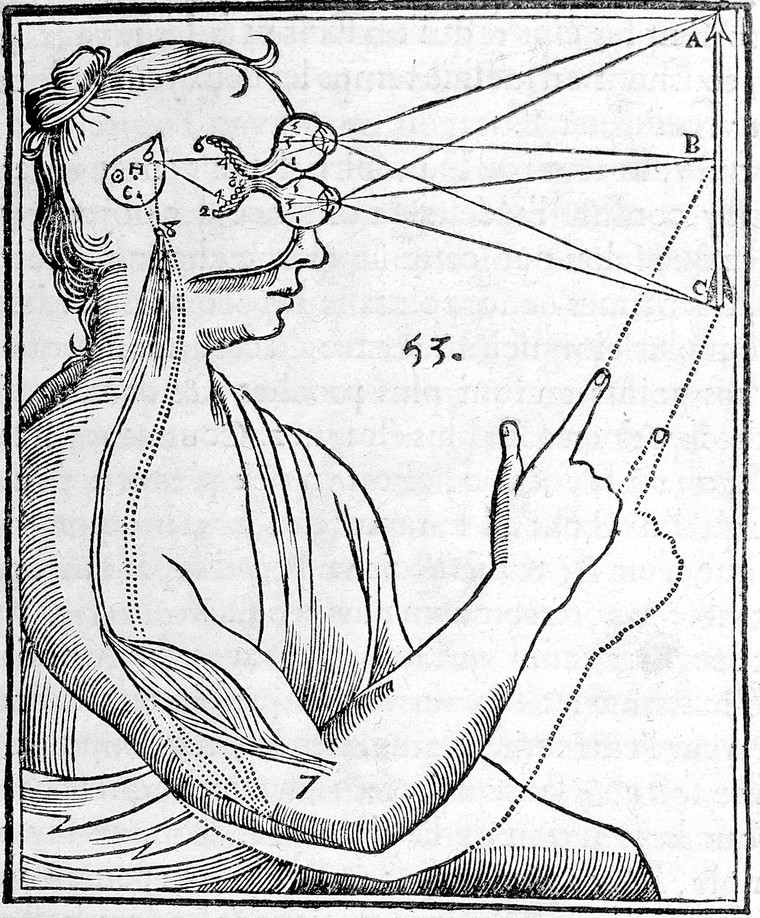
René Descartes: L’homme et un traitté de la formation du foetus (1664)

In some sense empiricism is an almost trivially true doctrine: in order to find out what the empirical world is like, some sort of empirical research is needed. And precisely in this sense empiricism is an integral part of current – and past – science. 

But in philosophy empiricism has had different, more substantial meanings. The most widespread of which is undoubtedly that experience is our only or predominant source of knowledge. Now, it goes without saying that there is an enormous difference between claiming that some sensory experience is required to gain knowledge of empirical reality and insisting that all knowledge is empirical.

Since The Helsinki Circle has adopted its name to honor the Vienna and Berlin Circles, one might be tempted to assume that we share the strict empiricist credos of our predecessors. This, however, would be a misconception. To demonstrate why this is so, we will offer for your enjoyment, our dear reader, a series of blog posts which explicate the errors of excessive empiricism.

One of the great mistakes that classical British empiricism was culpable, was the idea that experience is infallible, incorrigible, and indubitable. In other words, the traditional empiricists believed that experience itself cannot be wrong, refuted, or honestly doubted. This belief was passed on to the Viennese and Berlin philosophers and some remnants of it still exist today.

The infallibility of experience does not, of course, mean that we couldn’t make mistakes concerning the things we perceive. For instance, something might look like something else, say, a rock might look like a person, if one is observing it far enough away. The old empiricists did not deny this or the possibility of mirages, hallucinations, or illusions. Instead, they merely claimed that our experiences are such as they are and this is indisputable. 

Thus, if I see a hallucination of a person, hear voices, or taste something metallic, then the target of my hallucination does not exist. There is no one there, nobody is speaking to me, and there isn’t anything metallic in my mouth. Still, I nevertheless do have the sensations: I see, hear, or taste something even if there is nothing that corresponds to my experiences in the external world. And this is what empiricists have considered to be undeniable. 

At first blush, all this seems rather intuitive. But, as with many other empiricist dogmas, it is refuted by empirical evidence. In this case the refutation is due to a curious version of anosognosia called Anton-Babinski syndrome. Anosognosia is a condition caused by brain damage where a person with a disability is unaware of having said disability. For instance, someone can deny that they are partly paralyzed, and instead of accepting the truth the patient might use a number of defence mechanisms to account for her inability to move.

The Anton-Babinski syndrome is a highly unintuitive and rare version of anosognosia where a blind patient believes she can see. Someone with the syndrome will confabulate visual images which she claims to see. So, for example, she might say that someone has a red shirt on even though the person actually has a blue hoodie. Therefore, Anton-Babinski syndrome shows that we can have false beliefs concerning our experiences. In fact, we can believe to have perceptions when we have none. 

Usually, when people are presented with information concerning the syndrome and the conclusion that the doctrine of infallibility of experience is false, the the following objection is made: “Isn’t the Anton-Babinski syndrome just a type of hallucinating? Surely, the patients who have it, imagine visual experiences even if images are merely in their heads, right?”

Wrong. As Patricia Churchland neatly summarises:

“Are the patients with Anton’s syndrome really just mistaking visual imagery for actual vision? Drawing on anatomical data and behavioral tests, most clinical neurologists believe not. For one thing, the cortical regions needed for vision are also the regions believed to be needed for visual imagery, and these are the very ones destroyed[.]”

Patricia Churchland: Brain-Wise: Studies in Neurophilosophy (2002), p. 122

Churchland is saying here that the areas of the brain that are needed for producing visual hallucinations or visual imagery are destroyed in part or wholly with people who have the syndrome. Thus, at least in the cases where the regions do not exist at all, it is impossible that the patients are imagining things with their mind’s eye. 

Churchland also points out that “patients with Korsakoff’s syndrome (alcoholic dementia) freely confabulate about any subject” (Churchland 2002, 122). Hence, unconstrained confabulation is something that can happen even in other situations. Under certain neurological circumstances, we have the ability to fool ourselves of things that seem as certain as can be. Some researchers have even called confabulation in Anton-Babinski syndrome a type of “honest lying” (McNulty & Harbison 2015).

To sum up, the sincere belief of experiencing something does not guarantee that one is actually experiencing something. There is no choice but to accept fallibilism even with respect to perceptions. So much for the incorrigibility, infallibility, and indubitability of empirical knowledge.

References

Chen, Jiann-Jy; Chang, Hsin-Feng; Hsu, Yung-Chu & Chen, Dem-Lion (2015): “Anton-Babinski syndrome in an old patient: a case report and literature review” Psychogeriatrics 5 (1), pp. 58–61.

Churchland, Patricia Smith (2002): Brain-Wise: Studies in Neurophilosophy, Cambridge, MA: MIT Press.

Crumley II, Jack S. (2009): An Introduction to Epistemology, Peterborough: Broadview Press.

McNulty, M. & Harbison, J. (2015): “Honest Lying: Anton-Babinski Syndrome” Irish Journal of Medical Science 184 (Suppl. 7), pp. S287–S288.

O’Brien, Daniel: “The Epistemology of Perception” The Internet Encyclopedia of Philosophy, URL = https://www.iep.utm.edu/epis-per/

Perez-Ceballos, Sanlly; Fernandez-Rodriguez, Francisco T.; Shah, Neel; Wani-Parekh, Priyanka; Gondin-Hernandez, Lyan; Gonzalez-Martinez, Jose L.; Porres-Muñoz, Mateo & Porres-Aguilar, Mateo (2017): “The Eyes Are Useless When the Mind Is Blind: A Rare Case of Anton-Babinski Syndrome in Hepatic Encephalopathy” The American Journal of Medicine, 130 (5), pp. e215–e216.

Ramachandran, V. S. (1995): “Anosognosia in Parietal Lobe Syndrome” Consciousness and Cognition 4 (1), pp. 22–51.

Ramachandran, V. S. & Blakeslee, Sandra (1998): Phantoms in the Brain: Probing the Mysteries of the Human Mind, New York: Morrow.

An Addendum on Classification

Ilkka Pättiniemi

Last week in considering the realist and conventionalist arguments about the nature of classification, I ended up putting a weak – or perhaps even silly! – argument in the conventionalists mouth. Namely, I had the conventionalist claim that the following is an ampliative inference: “upon encountering a Dewey decimal for a previously unknown (at least for our investigator) book, if its code starts with an 8, one will be able to infer that it is a work of literature, and if with 88 a work of Greek literature and so on.” Here I wish to bolster the conventionalist’s case, and make less controversial the analogy between biological classification and library classification. A thought experiment is, alas, to be had. 

Consider the following scenario. Humankind has faced its extinction, but before said extinction it was decided that all books be classified and marked using the Dewey decimal system. A race of alien beings happen upon Earth to find the vestiges of a lost civilisation. Among the artifacts they discover weird sheets of pulped wood bound together bearing differing symbols. They come to see these objects as a means of sharing information in a textual form. But one thing baffles them: why do all of the books have this strange string of numbers in their cover page? To their great misfortune, the aliens never discover a book detailing the Dewey system, so they are forced to start building theories about the strings of numbers. So theories they construct. They make bold ampliative leaps: books with strings of numbers beginning with ‘8’ seem to contain fiction, so they surmise that any further works with an ‘8’ in the beginning of their string will be works of literature, and so on. Sometimes such inferences will be robust, but other times they will fail, and the alien theorists will be forced to revise their system. This, the conventionalist adamantly claims, is ampliative reasoning at its finest. The aliens’ theory of classification will allow for (fallible) inductive generalisations!

So, given the above, the realist and the conventionalist will continue to defend their intuitions and to pump their interlocutors’ intuitions with clever arguments and intuition pumps. And maybe what is needed is not a resolution for this dispute, but rather adoption of new, better intuitions. 

Finally, why care about our intuitions when it comes to classification – or anything else for that matter? Science is built on highly regimented everyday thought and observation, and as such it still carries residues of our intuitions and fallacies. Further, in order to make sense of what our best science tells us, we need a way to – partially, fallibly –  translate scientific claims into ordinary, everyday language. This will require satisfying at least some of our intuitions – for now, until we are able to develop new, better intuitions, ones that are better suited to our scientific worldview. This is Sellars’ project of negotiating between the scientific and the manifest images. We cannot do away with our intuitions any more than we can do away with language. We can, however, change our intuitions and our language for the better. For this reason it is important to look at our intuitions and critically evaluate and compare them. This pair of blog posts has hopefully gone some way towards that goal.  

They Are Merely Conventional Signs!, or, Realism, Conventionalism, and Classification

Ilkka Pättiniemi

When it comes to the subject of classification, a conventionalist view might at first blush seem quite welcoming. After all, many classificatory systems are in place for our convenience, and as such we should be free to change them if a new system seems to be doing a better job (given our needs). As examples one might take the many differing library classification systems, or The Harmonized Commodity Description and Coding System (HS) of the World Customs Organization – probably the most ambitious classification system ever created, as anything that might cross borders will have a place within the HS. The thing with such systems of classification is that we build them out of whole cloth; they are in no sense “found in the world”. So, here our intuitions might guide us to be conventionalists about classifications. They are things we impose on the world.

So, are all classificatory systems like HS or the Dewey Decimal system? Lewis Carroll provides us a reason to doubt this in his poem The Hunting of the Snark, where the map that the Bellman has provided is described thus: 

“What’s the good of Mercator’s North Poles and Equators,
Tropics, Zones, and Meridian Lines?”
So the Bellman would cry: and the crew would reply
“They are merely conventional signs!

“Other maps are such shapes, with their islands and capes!
But we’ve got our brave Captain to thank”
(So the crew would protest) that he’s bought us the best–
A perfect and absolute blank!”

Carroll 1876/1999, 683, emphasis in the original.

To Carroll’s eyes, if a system is not based on something real, it might as well not exist. How can we navigate the seas (or do mathematics for that matter[1]) based on convention? Carroll overshoots the mark, as no conventionalist worth their salt would say that a map lacking “such shapes, with their islands and capes” would be of any use, only that the choice of zones and meridian lines is quite arbitrary. Still he does raise a worry: can all things be classified by mere convention?

A realist would answer: “no, some classifications are natural and we find them through careful study of nature”. The realist can of course say that anyone is free to use some other classificatory system than the natural one, but such systems are built, not found. Natural systems include (says the realist) the system of elementary particles, the periodic table of elements, and the classification of taxa in biology. 

Take biological classification as an example. Although biological classification started more or less as an exercise in sorting similar looking organisms in the same families, it has now for a long time been based on evolutionary relations between organisms – relations that can (at least for extant organisms) be supported by genetic similarities. And it is not only that taxonomy is based on testable evolutionary relations, but biological classifications also allow for inductive generalisations. For instance, if you happen to know that a thus far unknown (at least to you) critter is in the family Felidae you will be able to surmise that it, among other things, will be a carnivore and will lack the capacity to digest (or taste!) sugars. Could such knowledge be gained from mere conventions? 

Here the conventionalist will interject: “But of course! We choose our conventions to aid us in navigating the world, and as such we would expect such success in these matters.” The realist will have none of it: “Such success is – must be – an indication that our classifications are tracking the structure of the world. So, insofar as there is success, there is a natural system of classification.” Here the conventionalist will point out that conventions such as the Dewey decimal system allow for inductive generalisations – upon encountering a Dewey decimal for a previously unknown (at least for our investigator) book, if its code starts with an 8, one will be able to infer that it is a work of literature, and if with 88 a work of Greek literature and so on. The realist will retort that this is a case of deduction rather than inductive generalisation. To which the conventionalist will reply: “is then not the case with Felidae also a case of deduction? In turn the realist will point out that success of non-natural systems is predicated in knowing the intent of the purposes of the system in question, an idea that plays little role in, say, biology or physics. And so it will go on, with thrust and parries, feints and ripostes, both sides claiming points and victories.  

For once I will leave things in as much disarray as I found them. I have no way of brokering peace between the realist and the conventionalist. But perhaps the whole question of “is x real or a product of convention?” is not a good question. (Compare: is x real or socially constructed?) Maybe we should only care about what we can do with x, with what role it can play in our investigations?

[1] Lewis Carroll was the nom de plume of the mathematician Charles Dodgson, who was quite opposed to conventionalism in mathematics and logic. 

References:
Carroll, Lewis (1876/1999) The Hunting of the Snark, in The Complete Lewis Carroll, Hertfordshire: Wordsworth Editions, 1999, 680–699.

How to Test a (Metaphysical) Theory?

Ilmari Hirvonen

Take any theory, model, or claim that is about something. Now, it seems rather obvious that there is a distinction to be made between what is true according to the theory and whether the theory itself is true. In order to make this clearer, consider Newton’s second law: F = ma. By substituting two of the variables with quantities, we can calculate what the third quantity should be. This tells us what is true according to the law.

However, if we want to know whether the law correctly describes the movements of bodies, we need to look up from our papers and engage with the world. In other words, we must observe the things that the law is about and see if they behave as Newton said they would. In this particular case, empirical work has shown that the second law gives a close approximation of certain situations but in others one has to use relativistic mechanics.

As a homage to Rudolf Carnap, let’s call questions that address what is correct according to the theory internal questions. After all, what a theory claims to be true is a matter internal to that theory. And, following the same meter, we shall name questions that concern the truth of the theory external questions. One cannot determine the correctness of a theory by merely looking at the theory itself, it is an external matter.

It is important to note that the distinction I’ve offered here is not the same as the one Carnap made in his article “Empiricism, Semantics, and Ontology” (1950). Though, there are some similitudes – it is not totally arbitrary that I chose to use the same terms as he did. However, explicating the differences and similarities would be beside the point of this blog post. So, if your interest lies more in the history of philosophy, I recommend reading Carnap’s original text.

We can take a closer look at philosophical theories, including metaphysical ones, from the perspective of these two kinds of questions. And it’s good to keep in mind that one cannot say that a metaphysical theory is true just by looking at the theory itself. Just like determining whether Newton’s second law is correct requires more than merely examining the law on it’s own. One cannot answer external questions simply as a by-product of attending to internal questions. Something more is needed.

Now, with respect to metaphysics there is a curious discovery to be made: Metaphysical theories are supposed to be about the world, this world, the empirically accessible world. And yet it’s very difficult, perhaps impossible, to evaluate them empirically. This raises the question: why should we think that the theories are actually about the empirical world at all? Some metaphysicians could even admit that this is not what they are supposed to do. The ontologists might say that metaphysical theories concern the metaphysical, not the empirical, realm.

Well, this would be a good answer, if it wasn’t for the fact that at least some metaphysical theories clearly deal with targets located in the empirical world. Metaphysicians ask such questions as whether holes or people exist, what is the essence of dogs, when does a lump of clay become a statue, and so on. These questions, and the answers to them, are evidently about actual holes, people, dogs, and statues. So, it isn’t clear why we should think that metaphysical theories are not about the empirical world.

But all this is connected to an even larger problem, namely, the fact that there is no agreement on which of the metaphysical theories are correct or even how we should assess them. That is to say, there is no consensus about how to answer external questions about metaphysics.

One suggestion is that metaphysical theories should be evaluated on their theoretical virtues, such as coherence, simplicity, and explanatory power. This would offer a way to answer external questions on the correctness of metaphysical theories. But note that the proposal is also in itself a philosophical theory. It is a metametaphysical, a metaontological, or a metaphilosophical theory.

Therefore, here too one can separate internal and external questions. To the internal question: “What is true according to the theory?” we can answer: “The correctness of metaphysical theories should be evaluated with theoretical virtues.” But we still need to give a reply to the external question: “Is this metametaphysical theory correct?” and this requires some way to assess the metaontological position.

Some have claimed that the metaphilosophical position is true, because the same theoretical virtues are applied in science and the tremendous success of science justifies these virtues (see, e.g., Paul 2012). If it is true that also scientists utilise these virtues, then this would indeed be a strong argument for the metametaphysical theory.

But alas! Others have pointed out that the same virtues are not used in science, they are not used in the same way as metaphysicians use them, they are not able to make a difference between metaphysical theories, or they are not truth-conducive (see, e.g., Sober 1988; Bennett 2009; Ladyman 2012; Kriegel 2013; Benovsky 2014). (I’m grateful to Henrik Saarinen for helping with the references on current metaphysical debates.)

Thus, the metaphysician is left with the following conundrums: First, why can’t metaphysical theories be evaluated empirically, given that they concern the empirical world? Second, if they are not about empirical reality, what reality do they refer to? Third, why should this non-empirical world be postulated in the first place? Fourth, how should the theories be evaluated, if not empirically? And fifth, on what basis would this other way of assessing them truly say anything about their correctness?

Before dealing with these problems, we cannot give justified answers to external questions in metaphysics. And without being able to answer the external questions, the internal questions don’t appear to be that interesting. That is, before we have a solid epistemology of metaphysics there is no real point in doing metaphysics. Let’s wait and see whether one is coming.

References

Bennett, Karen (2009): “Composition, Colocation, and Metaontology” in Metametaphysics: New Essays on the Foundations of Ontology, David Chalmers, David Manley, and Ryan Wasserman (eds.), 38–76.

Benovsky, Jiri (2014): “Tropes or Universals: How (Not) to Make One’s Choice” Metaphilosophy 45(1): 69–86.

Carnap, Rudolf (1950): “Empiricism, Semantics, and Ontology” Revue Internationale de Philosophie, 4(11): 20–40.

Kriegel, Uriah (2013): “The Epistemological Challenge of Revisionary Metaphysics” Philosophers’ Imprint 13(12): 1–30.

Ladyman, James (2012): “Science, metaphysics, and method” Philosophical Studies, 160(1): 31–51.

Paul, L. A. (2012): “Metaphysics as modeling: the handmaiden’s tale” Philosophical Studies, 160(1): 1–29.Sober, Elliott (1988): Reconstructing the Past: Parsimony, Evolution, and Inference, Cambridge, MA: The MIT Press.

The Spirit of Verificationism

Ilkka Pättiniemi

In philosophy verificationism seems to often enter the fray when one or more thinkers come to realize that the field has become stale and sterile – old ideas show no way forward, no way of settling controversies. The old ways of doing things have, the verificationist thinks, gotten us stuck. Verificationism, then, is an attempt to get rid of bad old ideas and to give a roadmap for avoiding getting stuck the same way later on. I will take the opportunity here to sketch out the spirit of verificationism, and to recommend the reader to take an open minded look to see if verificationist ideas might just be “glamorous, exciting and exactly what the age demands” (Rorty 1993: 198).

In her book Verificationism: Its History and Prospects (1995), C. J. Misak takes as a main part of the verificationist spirit the idea that “A belief with no connection to experience is spurious” (Misak 1995: vii). This will obviously closely align the verificationist with empiricism, and indeed many verificationists have been empiricists of one kind or another – although the two are in no way coextensive as pragmatist philosophers such as Charles Sanders Peirce and Richard Rorty are not empiricists, but still embrace verificationism. (I am merely pointing out that the aims of empiricists and the aims of verificationists are often quite close to one another.) Another major part of the verificationist spirit is the demand to not block the way to inquiry. Here some might complain: any kind of verificationist restriction on methods of inquiry will block some lines of thought. Thus such a criterion, precisely, blocks inquiry! But, the verificationist will answer, what is inquiry without any constraints? It is no inquiry at all! To distinguish inquiry form, say, hat-making one needs to have criteria for what counts as inquiry (and millinery for that matter). A third part is the demand for our concepts to be applicable, to serve a purpose in our inquiries. Of note here, is that the verificationist demand is not a demand for total verification, but rather a demand that a claim makes a practical difference.

So the spirit of verificationism can then be summed up as follows: Claims should be connected to (even if minutely) to experience, the methods of inquiry need to have constraints, and concepts used should be applicable. This, I hope, does not look at all as insidious as the opponents of verificationists have made it sound. (And note that falsificationist views are just a subset of verificationism.)

Some quotes to flesh things out: 

[Verificationist view of] truth is […] divested of its absolute […] character; it is made relative and reduced to human terms, but the concept of truth becomes applicable! And what purpose could be served by a concept of truth which is inapplicable?

Hans Hahn, quoted in Mizak 1995: 89, emphasis added.

[If] nothing can be deduced from [a] theory […] this stamps the theory as one of those to which Auguste Comte applied the epithet metaphysical, that is unverifiable. To accept it as sufficient would be to block the road to inquiry.

Charles Sanders Peirce, quoted in Mizak 1995: 92, emphasis added.

[Anti-verificationist] intuitions are giving rise to too much sterile controversy, too many fancy theories which tack epicycles […] onto epicycles, too much speculation […] for an as-yet-unimaginable breakthrough before we can hope to reach the light, too much defeatist guff about ‘the limits of science.’ In short, we want new [verificationist] intuitions because the old ones haven’t been getting us anywhere.

Richard Rorty 1993: 199.

So, why should one adopt the verificationist spirit? It depends on what one wishes to accomplish. If one is content playing idle word games with one’s esteemed colleagues, one might do well to stick to one’s non-verificationist ways. But if one desires to understand the world, and to change it, one does well to a method of inquiry that can accomplish exactly that: allows us to make useful distinctions and conceptualisations. Further, verificationism is opposed to revelation, dogma, superstition, and unconsidered appeals to tradition – things often opposed to social change for the better. So, if one wishes for a change for the better – for social justice, as it were – one should consider opting for the verificationist way of doing things. Dogmatism and traditions crumble before the might of the questions “how do you justify your claim?”, “how would things be different if you were wrong?” and their ilk. Come join us. We have cookies!

References:

Misak, C. J. (1995): Verificationism: Its History and Prospects, London: Routledge.
Rorty, Richard (1993): Holisim, Intrinsicality, and the Ambition of Trancendence, in Bo Dahlbom (ed.) Dennett and his Critics, Oxford: Blackwell, pp. 184–202.

NB: what I have written in these blog posts should not be considered a programmatic declaration of the official view of the Helsinki Circle, but rather as the musings and opinions of a single member. 

Design a site like this with WordPress.com
Get started